Key Takeaways
- The HUD Code is a federal safety and construction standard for manufactured homes
- It has applied to all manufactured homes built since June 15, 1976
- HUD-compliant homes have HUD certification labels and a HUD data plate
- HUD Code compliance affects financing, insurance, and resale value
- Many buyers ask, what is the HUD code, when verifying whether a manufactured home meets federal construction standards.
 The HUD Code is a federal construction and safety standard that regulates how manufactured homes are built in the United States.
 The HUD Code is a federal construction and safety standard that regulates how manufactured homes are built in the United States.
It has been in effect since June 15, 1976 and is enforced by the U.S. Department of Housing and Urban Development. Any manufactured home built after this date must meet HUD Code requirements.
What Does the HUD Code Mean?
What is the HUD code? It is the set of regulations that governs how manufactured homes are built and inspected. The HUD Code establishes a single, nationwide set of building standards for manufactured homes. Before 1976, factory-built homes were constructed under varying state and local rules, which often resulted in inconsistent quality and safety. The HUD Code created uniform standards covering structural strength, fire safety, energy efficiency, plumbing, electrical systems, heating, ventilation, and transportation.
These rules apply only to homes built entirely in a factory and then transported to a site. They do not apply to site-built houses or modular homes.
Why Was the HUD Code Created?
The HUD Code was created to improve safety and construction quality while protecting homeowners. It also allows manufactured homes to be built to one consistent standard and legally moved and installed across state lines. Over time, this consistency has increased buyer confidence and made it easier for lenders and insurers to support manufactured housing. Understanding what is the HUD code helps buyers confirm the safety and quality of a manufactured home.
How Can You Tell If a Home Is HUD Code Compliant?
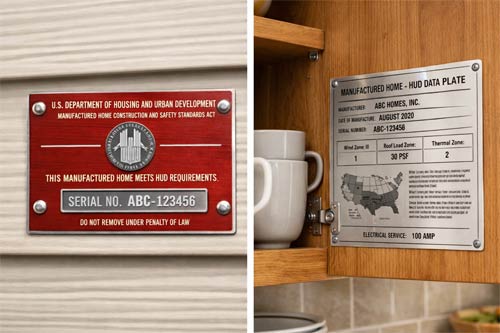 HUD Code homes have two primary identifiers. The first is the HUD certification label, often called the HUD tag. This is a small metal plate attached to the exterior of the home, usually on the back of each section. Multi-section homes will have one label per section. When shopping for factory-built housing, people often wonder, what is the HUD code, and why it matters.
The second identifier is the HUD data plate, which is located inside the home. It is commonly found inside a kitchen cabinet, electrical panel, or bedroom closet. The data plate lists important information such as the manufacturer, build date, wind zone, roof load, and thermal zone.
Together, these confirm the home was built to HUD Code standards.
What Homes Are Covered by the HUD Code?
The HUD Code applies to manufactured homes built after June 15, 1976, including single-wide, double-wide, and multi-section homes. It does not apply to older mobile homes built before 1976, modular homes constructed to local building codes, recreational vehicles, or park models. What is the HUD code? It ensures manufactured homes comply with national standards for design, durability, and energy efficiency.
HUD Code vs. Mobile Home: What’s the Difference?
The term mobile home is commonly used to describe factory-built homes constructed before 1976. Homes built after 1976 are legally classified as manufactured homes and must comply with the HUD Code. While many people still use the term “mobile home,” HUD Code compliance is what matters legally for financing, insurance, and resale.

Why the HUD Code Matters When Buying or Selling
HUD Code compliance plays a major role in financing, insurance, and resale value. Most lenders require proof that a home meets HUD standards before approving loans. Insurance companies often request HUD label numbers or data plate information before issuing a policy. Homes that are HUD Code compliant are generally easier to sell and attract more qualified buyers. Lenders and insurers may ask what is the HUD codebefore approving financing or coverage.
What If the HUD Label Is Missing?
Missing HUD labels are common, especially on older manufactured homes. In many cases, replacement labels or verification can be requested through the manufacturer or approved agencies. A missing label does not automatically mean the home is non-compliant, but it can slow down financing or resale if documentation is not available.
Does the HUD Code Change Over Time?
Yes. The HUD Code is updated periodically to improve safety, energy efficiency, and durability standards. Manufactured homes are built to the version of the HUD Code that was in effect at the time of construction, not the current version. Knowing what is the HUD code can help homeowners identify whether their home qualifies as a manufactured home rather than a mobile home.